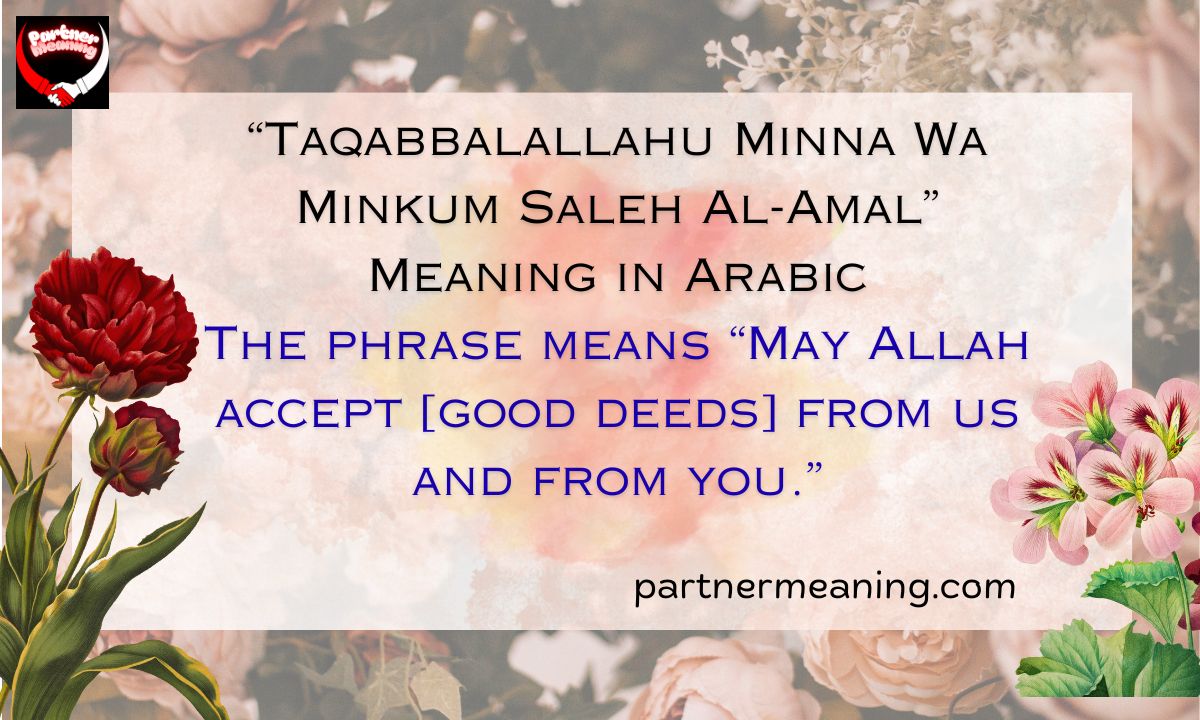
Taqabbalallahu Minna Wa Minkum Saleh Al-Amal is a beautiful Arabic phrase often used during Eid celebrations. Muslims greet each other with it, praying for acceptance of good deeds. Saying this shows unity, blessings, and goodwill among family and friends.
What Does Taqabbalallahu Minna Wa Minkum Mean?
The phrase Taqabbalallahu Minna Wa Minkum means “May Allah accept [good deeds] from us and from you.” It is often said during عيد الفطر (Eid al-Fitr) and عيد الأضحى (Eid al-Adha). Muslims use it to pray for each other’s رَضا الله (pleasure of Allah).
It is a common dua exchanged between family and friends on Eid. Saying it shows unity and a shared desire for Allah’s acceptance. People often combine it with Eid greetings.
You can also add saleh al-amal (صالح الأعمال) to emphasize righteous deeds. Some shorten it to just Taqabbalallahu minna wa minkum. The meaning stays intact.
Using this phrase is a Sunnah way to express spiritual goodwill. It encourages love, respect, and prayers among Muslims. Its usage strengthens community bonds.
Arabic Writing and Pronunciation of Taqabbalallahu Minna Wa Minkum
In Arabic, it is written:
تَقَبَّلَ اللهُ مِنَّا وَمِنكُم
The pronunciation can vary slightly. Common transliterations include:
| Transliteration | Notes |
| Taqabbalallahu minna wa minkum | Most common |
| Taqabbal-Allâhu minnâ wa minkum | Formal style |
| Taqaballahu Minna Wa Minkum | Simplified version |
The word Taqabbal (تَقَبَّلَ) means accept. Minna (مِنَّا) means from us. Wa minkum (وَمِنكُم) means and from you. Adding saleh al-amal (صالح الأعمال) highlights good deeds.
Pronouncing it correctly is important. Mispronouncing taqabbal as taqabal changes the meaning. Using correct Arabic pronunciation preserves the blessing of the dua.
The Spiritual Significance of Taqabbalallahu Minna Wa Minkum
This phrase is a way to ask Allah for acceptance of deeds. It strengthens the connection with Allah and expresses gratitude. Using it reminds Muslims of the importance of worship.
It promotes unity among family and friends. Saying it together during Eid builds a sense of community. It symbolizes love, respect, and spiritual care.
Adding saleh al-amal (صالح الأعمال) emphasizes righteous actions. This encourages good behavior throughout the year. It links celebration with spiritual growth.
Even exchanging the phrase in a simple greeting brings reward and blessings. It shows a Muslim’s intention to follow Sunnah practices.
Origin of Taqabbalallahu Minna Wa Minkum in Hadith
This dua comes from a Hadith narrated by Jubayr ibn Nufayr. He said the companions of the Prophet ﷺ would greet each other on Eid with this phrase.
Al-Haafiz described the isnaad (chain of narration) as hasan (good). This confirms its authenticity. Using it follows the example of the Prophet ﷺ.
Imam Ahmad mentioned that saying Taqabbalallahu Minna Wa Minkum on Eid is acceptable. It is a Sunnah greeting, along with Eid Mubarak.
The tradition highlights mutual prayers for acceptance. It reflects the spiritual culture of the early Muslim community.
How and When to Say Taqabbalallahu Minna Wa Minkum
It is mainly said on Eid days after صلاة العيد (Eid prayer). You can greet family, friends, and neighbors. It is polite to respond back with the same phrase.
You may also say Ameen or Khair Mubarak in response. This shows mutual respect and shared prayers.
It can be said in formal or informal settings. Using Arabic pronunciation is preferred but not mandatory.
Examples in sentences:
| Arabic Sentence | English Translation |
| تقبّل الله منا ومنكم صالح الأعمال | May Allah accept good deeds from us and you |
| بعد صلاة العيد سلمت عليه وقلت: تقبّل الله طاعاتكم | After Eid prayer, I greeted him and said: May Allah accept your acts of worship |
Using the dua properly enhances Eid greetings. It combines spiritual meaning with social etiquette.
Common Mistakes in Saying Taqabbalallahu Minna Wa Minkum
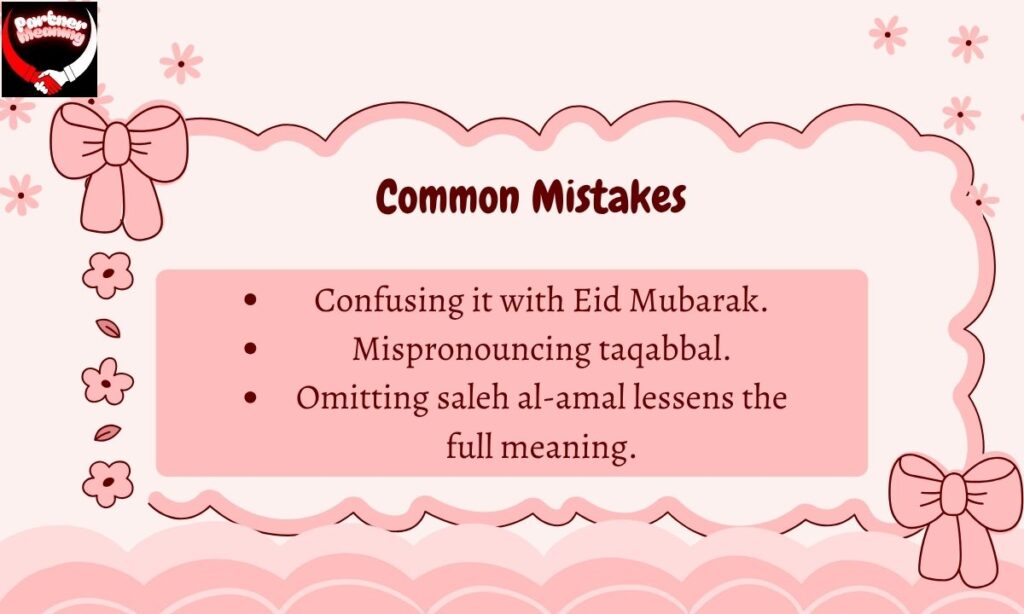
One common mistake is mispronouncing “taqabbal” as taqabal. This changes the meaning slightly. Correct pronunciation is تَقَبَّلَ.
Another mistake is omitting “saleh al-amal (صالح الأعمال)”. While optional, including it emphasizes righteous deeds. It gives the dua fuller meaning.
Some people confuse it with Eid Mubarak. Eid Mubarak is a general greeting, while Taqabbalallahu is a supplication. Both can be said together.
Using the phrase out of context is also incorrect. It should be said on Eid days or after worship, not randomly. Proper timing ensures its blessing and authenticity.
Cultural Importance of Taqabbalallahu Minna Wa Minkum During Eid
The phrase strengthens family and community bonds during Eid. Saying it together shows unity and spiritual care.
It reflects the tradition of the Prophet ﷺ. The companions exchanged it as a way of celebrating Eid.
It connects spiritual practices with social etiquette. Muslims learn mutual respect and goodwill through this greeting.
Using it preserves Islamic heritage. It keeps alive the Sunnah of the early Muslim community and encourages others to follow it.
Benefits of Learning Taqabbalallahu Minna Wa Minkum for Muslims
Learning this dua improves Arabic language skills. It helps with pronunciation and understanding of key words like taqabbal and saleh al-amal.
It strengthens religious knowledge. Muslims understand the importance of acceptance of deeds and Sunnah greetings.
It enhances social interaction during Eid. Exchanging the dua shows respect, care, and blessings to others.
It increases spiritual awareness. Using this phrase reminds Muslims of accountability and devotion to Allah.
Examples of Taqabbalallahu Minna Wa Minkum in Sentences
Muslims say Taqabbalallahu Minna Wa Minkum Saleh Al-Amal during Eid prayers and greetings. For example:
“تقبّل الله منا ومنكم صالح الأعمال” – “May Allah accept good deeds from us and you.”
“في العيد نقول: تقبّل الله منا ومنكم” – “On Eid, we say: May Allah accept from us and you.”
“بعد الصلاة سلمت عليه وقلت: تقبّل الله طاعاتكم” – “After the prayer, I greeted him and said: May Allah accept your acts of worship.”
“تقبّل الله منا ومنكم، كل عام وأنتم بخير” – “May Allah accept from us and you; wishing you a blessed year.”
Using examples helps memorization and correct usage. It also shows how the phrase fits everyday Eid greetings.
Frequently Asked Questions
What is the meaning of Taqabbalallahu Minna Wa Minkum?
It means “May Allah accept [good deeds] from us and from you.”
How do you pronounce Taqabbalallahu Minna Wa Minkum correctly?
Pronounce it as تَقَبَّلَ اللهُ مِنَّا وَمِنكُم (Taqabbalallahu Minna Wa Minkum).
Is Taqabbalallahu Minna Wa Minkum a Quranic verse?
No, it is a Sunnah dua from Hadith, not directly from the Quran.
Can I say Eid Mubarak instead of Taqabbalallahu Minna Wa Minkum?
Yes, Eid Mubarak is acceptable, but Taqabbalallahu is a supplication for acceptance of deeds.
What is the proper reply to Taqabbalallahu Minna Wa Minkum?
You can reply with the same phrase, or say Ameen or Khair Mubarak.
Does adding “Saleh Al-Amal” change the meaning?
Yes, it emphasizes righteous deeds and adds fuller meaning to the dua.
Conclusion
Taqabbalallahu Minna Wa Minkum Saleh Al-Amal is a beautiful Eid greeting. It prays for acceptance of deeds and strengthens unity among Muslims. Using it correctly follows the Sunnah of the Prophet ﷺ. Learning this dua enhances both spiritual and social connection during celebrations.

Hayyat is a passionate writer and researcher who loves exploring the beauty and depth of Arabic language and culture. With a special interest in Arabic names, Qur’anic words, and Islamic heritage, Hayyat aims to share meaningful insights with readers who appreciate names with purpose and history.