Learning Egyptian Arabic is the key to connecting with locals and experiencing real Egyptian life. These common Arabic words will help you greet, thank, and express yourself easily. Start with a few and you’ll sound more natural and confident in no time.
What Does Egyptian Arabic Words Mean?
Egyptian Arabic (Masri) is the spoken language of Egypt, understood across the Arab world because of Egyptian movies, songs, and media. It’s a colloquial form of Arabic, different from Modern Standard Arabic, yet easier and more expressive. Egyptians use it daily for conversations, jokes, and social interactions.
This version of Arabic reflects Egyptian culture, humor, and identity. The tone is warm and lively, often full of emotion and friendly gestures. While it borrows from Classical Arabic, it has its own unique pronunciation, rhythm, and phrases.
When people refer to Egyptian Arabic words, they mean everyday terms like “Aiwa” (Yes), “La” (No), or “Shokran” (Thank you) — simple yet powerful expressions that make communication easy and natural.
Why Learn Egyptian Arabic?
Learning Egyptian Arabic opens doors to authentic cultural experiences. Since Egypt is one of the most influential Arabic-speaking nations, understanding its dialect helps you connect with millions of native speakers across the region.
It’s also the most widely understood dialect in the Arab world, thanks to Egyptian cinema, TV, and music. When you learn Masri, you can easily communicate in markets, cafes, or while traveling through Cairo and Alexandria.
Benefits of learning Egyptian Arabic:
- Speak naturally with locals in Egypt and nearby countries.
- Understand popular Arabic songs, films, and shows.
- Build genuine friendships with native speakers.
- Experience Egyptian culture beyond tourist attractions.
“Even a few Egyptian Arabic words can earn you instant smiles and respect from locals.”
Basic Egyptian Arabic Vocabulary
These are the foundation words every beginner should know. They help you greet, thank, and respond politely in daily life. Most of these are short and easy to pronounce.
| Arabic Script | Transliteration | English Meaning |
|---|---|---|
| السلام عليكم | Elsalam alekom | Hello / Peace be upon you |
| شكراً | Shokran | Thank you |
| عفواً | Afwan | You’re welcome |
| تمام | Tamam | Okay / Fine |
| يلا | Yalla | Let’s go |
| إن شاء الله | InshaAllah | God willing |
| من فضلك | Min fadlak | Please |
| حاضر | Hader | Right away / Understood |
These words form the core of Egyptian communication, making you sound friendly and respectful in any setting.
Everyday Egyptian Words and Phrases
Daily life in Egypt is full of expressive phrases that carry warmth and humor. You’ll hear people using them in shops, taxis, and even casual greetings.
Examples of common phrases:
- “Mashi” – Okay / Fine
- “Khalas” – Done / Enough
- “Mafish moshkela” – No problem
- “Ana mish fahm” – I don’t understand (for men)
- “Ana 3ayez mayah” – I want water
“Egyptian Arabic is full of life — every word tells a story and every phrase carries emotion.”
Learning these phrases will help you fit into Egyptian society and understand conversations beyond textbook Arabic. Egyptians appreciate effort, so even short exchanges make a lasting impression.
Popular Egyptian Greeting Words
Greetings are an essential part of Egyptian culture, used to show respect and friendliness. People often greet each other warmly, no matter the time or place.
| Arabic Script | Transliteration | English Meaning |
|---|---|---|
| صباح الخير | Sabah el-kheer | Good morning |
| مساء الخير | Masa el-kheer | Good evening |
| ازيك؟ | Iz-zayak? (m) / Iz-zayek? (f) | How are you? |
| الحمد لله | El-hamdulillah | Praise be to God / I’m fine |
| مع السلامة | Ma’a el-salama | Goodbye |
| تصبح على خير | Tesbah ala kheer | Good night |
These greetings are used multiple times a day. Egyptians often combine them with friendly smiles or light jokes. Saying “Sabah el-kheer” in the morning instantly makes conversations more pleasant.
In Egyptian culture, a good greeting can start a friendship. Try using these phrases next time you meet someone new — it’s a small gesture with a big impact.
Easy Egyptian Arabic Words for Beginners
Starting with simple Egyptian Arabic words helps beginners build confidence. These are short, common, and used every day in Egypt. Learning them will make your first conversations smoother and more enjoyable.
| Arabic Script | Transliteration | English Meaning |
|---|---|---|
| نعم | Na’am | Yes |
| لا | La | No |
| شكراً | Shokran | Thank you |
| آسف | Asif | Sorry |
| فين؟ | Fein? | Where? |
| كام؟ | Kam? | How much? |
“Learn a few words a day — soon, small steps will make big progress.”
Practice these words with locals, taxi drivers, or shopkeepers. Egyptians are patient and appreciate anyone who tries to speak their dialect.
Useful Words for Tourists in Egypt
Tourists visiting Egypt will find these practical Arabic words extremely helpful. They cover directions, shopping, greetings, and basic needs.
Essential travel words:
- “Hammam” – Bathroom
- “Bikam da?” – How much is this?
- “La shukran” – No, thank you
- “Ana mish fahm” – I don’t understand
- “Fein el otel?” – Where is the hotel?
“A few polite words in Arabic can turn a tourist into a welcome guest.”
Using even simple phrases like “Shokran” or “Afwan” will earn you friendly smiles and better service. Egyptians love when visitors make the effort to speak their language.
Common Verbs in Egyptian Arabic
Knowing basic verbs makes it easier to form sentences and express daily actions. Egyptian Arabic verbs are often short and easy to memorize.
| Arabic Verb | Transliteration | English Meaning |
|---|---|---|
| أكل | Akal | To eat |
| شرب | Sherib | To drink |
| راح | Rah | To go |
| جه | Geh | To come |
| شاف | Shaf | To see |
| سمع | Seme’a | To hear |
You can combine these verbs with pronouns for basic sentences like “Ana akalt” (I ate) or “Enta rahet?” (Did you go?). Over time, you’ll start to form natural Egyptian-style conversations.
“Master verbs first — they’re the heart of every spoken phrase.”
Egyptian Arabic Words for Daily Conversation
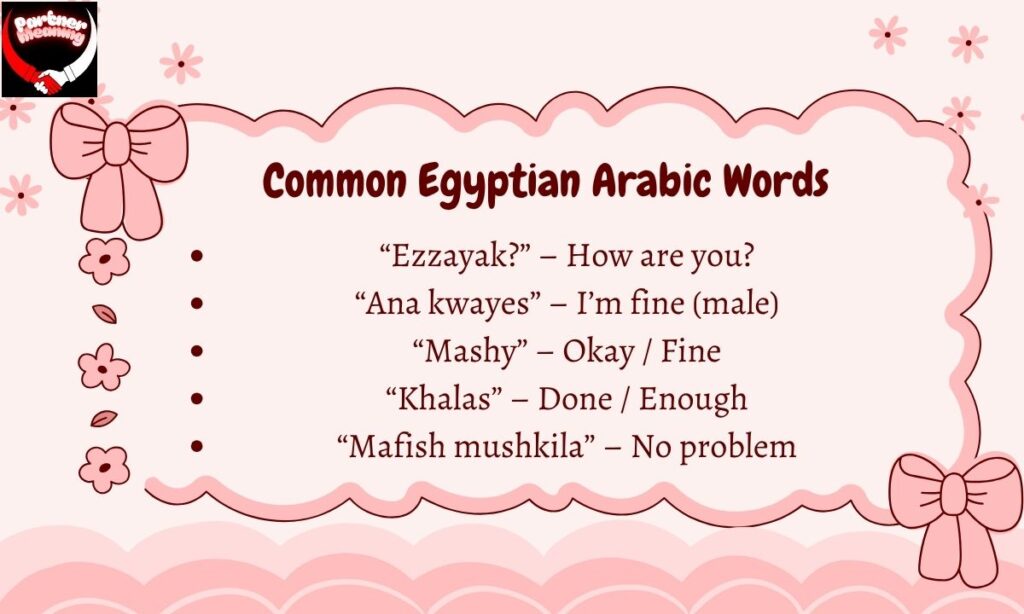
Daily conversations in Egypt are lively, friendly, and full of expressions. These everyday phrases help you blend into local life and understand humor or emotion.
Common conversational phrases:
- “Ezzayak?” – How are you?
- “Ana kwayes” – I’m fine (male)
- “Mashy” – Okay / Fine
- “Khalas” – Done / Enough
- “Mafish mushkila” – No problem
“In Egypt, conversations are more about connection than perfection.”
Using these words naturally will make you sound more fluent. Egyptians often repeat or shorten words for warmth and friendliness, so don’t worry about grammar — just speak from the heart.
Polite Expressions and Good Words in Egyptian Arabic
Politeness is very important in Egyptian culture. People often use kind and respectful words when talking to others, even strangers.
| Arabic Script | Transliteration | English Meaning |
|---|---|---|
| من فضلك | Min fadlak | Please |
| شكراً جزيلاً | Shokran gazilan | Thank you very much |
| لو سمحت | Law samaht | Excuse me |
| حاضر | Hader | Sure / Right away |
| ربنا يخليك | Rabbena ykhalik | May God protect you |
“A polite word in Arabic is more valuable than gold.”
Using these expressions often leaves a good impression. Egyptians value respect and warmth, and polite speech reflects both.
Essential Egyptian Arabic Words with English Translation
Here’s a quick table of essential words every learner should memorize. These cover greetings, emotions, and basic objects.
| Arabic Word | Transliteration | English Meaning |
|---|---|---|
| بيت | Beit | House |
| فلوس | Felous | Money |
| صاحب | Saheb | Friend |
| أكل | Akel | Food |
| شمس | Shams | Sun |
| مية | Mayya | Water |
These words are part of daily life and appear in almost every conversation. Start using them in simple sentences like “Ana fi el beit” (I’m at home) or “Ayez mayya” (I want water).
“The more words you know, the closer you get to the heart of Egyptian culture.”
Learn Arabic Pronunciation and Script Basics
Learning Arabic pronunciation and script is the foundation of speaking Egyptian Arabic correctly. Arabic is written from right to left, and its letters change shape depending on their position in a word. The alphabet has 28 letters, all representing consonants, while vowels are shown using small marks called Harakat.
The three main vowels are a (fat-ha), i (kasra), and u (damma). Each can be short or long, and long vowels are held for about twice as long. For example, “kitab” (book) has a short “i,” while “kitaab” has a long “a.” These small differences can change the entire meaning of a word.
| Symbol | Arabic Name | Sound Example |
|---|---|---|
| َ | Fatha | short “a” like in “cat” |
| ِ | Kasra | short “i” like in “sit” |
| ُ | Damma | short “u” like in “put” |
“Every sound in Arabic has a rhythm — listen, repeat, and you’ll find your flow.”
Reading Arabic takes practice, but the script is logical once you get used to the patterns. Many learners start by recognizing familiar words like “Allah”, “Salam”, or “Masr” (Egypt) to get comfortable with the letters and pronunciation.
How Egyptian Arabic Differs from Modern Standard Arabic
Egyptian Arabic (Masry) is the most widely understood dialect in the Arab world because of Egyptian movies, songs, and media. However, it’s quite different from Modern Standard Arabic (MSA), which is used in writing, news, and formal speech.
MSA is more grammatical and follows classical Arabic rules. Egyptian Arabic is relaxed, with simplified grammar and its own slang. For example, “Ana ureed” (I want) in MSA becomes “Ana ayez” in Egyptian Arabic — shorter and easier to say.
| MSA Phrase | Egyptian Arabic | English Meaning |
|---|---|---|
| كيف حالك؟ (Kayfa haluk?) | إزيّك؟ (Ezzayak?) | How are you? |
| نعم (Na’am) | أيوه (Aiwa) | Yes |
| لا (La) | لأ (La’a) | No |
| أريد (Ureed) | عايز (Ayez) | I want |
“If you understand Egyptian Arabic, you can talk to millions — it’s the bridge of Arab culture.”
Egyptian Arabic is used in homes, streets, and markets. It’s friendly, emotional, and full of humor, making it the perfect dialect to start with if you want to connect with people easily.
Tips to Learn Egyptian Arabic Fast
Learning Egyptian Arabic quickly is possible if you stay consistent and immerse yourself in the language daily. Start by listening more than you speak. Watch Egyptian movies, listen to local songs, and repeat phrases out loud to copy the accent.
Useful learning tips:
- Practice short conversations with locals or online tutors.
- Use flashcards for 10 new words each day.
- Listen to Egyptian YouTube channels or radio.
- Record yourself speaking and compare with native pronunciation.
“Don’t aim for perfection — aim for connection.”
Focus on common daily words like greetings, directions, and numbers first. These form 70% of casual speech. Over time, mix in verbs and short sentences such as “Ana gay min Masr” (I’m from Egypt) or “Enta kwayes?” (Are you fine?). The key is daily practice, not speed.
Final Thoughts
Learning Egyptian Arabic vocabulary opens doors to real communication and cultural understanding. Start small, focus on daily words, and use them often in conversation. The more you listen and repeat, the more natural you’ll sound. With time, you’ll not just speak Arabic — you’ll feel it.
Frequently Asked Questions
What are the most common Egyptian Arabic words?
Words like Salam, Shokran, Mashi, Aiwa, and Habibi are used every day.
Is Egyptian Arabic hard to learn for beginners?
Not really — it’s easier than classical Arabic and very conversational.
What’s the difference between Standard Arabic and Egyptian Arabic?
Standard Arabic is formal; Egyptian Arabic is casual and used in daily life.
How can I learn to speak Egyptian Arabic quickly?
Practice daily, watch Egyptian shows, and talk to native speakers.
Which Arabic words should tourists in Egypt know?
La shokran, Bikam da, Min fadlak, Mashi, and InshaAllah are must-know phrases.
Do Egyptians understand Modern Standard Arabic?
Yes, most educated Egyptians understand it, but they prefer their local dialect in daily talk.

Hayyat is a passionate writer and researcher who loves exploring the beauty and depth of Arabic language and culture. With a special interest in Arabic names, Qur’anic words, and Islamic heritage, Hayyat aims to share meaningful insights with readers who appreciate names with purpose and history.