Salamat is a powerful Arabic word often used in everyday life. It reflects positivity, safety, and blessings in conversations. Understanding Salamat can bring peace and goodwill to your words and interactions.
What Does Salamat (سلامات) Mean in Arabic?
Salamat (سلامات) is a word full of positivity and goodwill. It is commonly used to express safety, well-being, and blessings in daily conversations. People often use it when wishing someone good health or protection. The word reflects a sense of peace and care in interactions.
In Arabic, سلامات can also indicate protection or intactness in different situations. It is related to the root word Salam (سلام), which means peace. Using Salamat in speech shows kindness and thoughtful intentions. It is more than a word; it is a cultural gesture of care.
The term is universal in Arabic-speaking communities, appearing in greetings, farewells, and expressions of goodwill. It conveys positive energy and is often combined with prayers or kind phrases. Many parents also choose it as a name for boys and girls, symbolizing protection and blessings.
In short, Salamat (سلامات) is not just a word; it is a reflection of safety, peace, and well-being. Using it properly in conversations adds warmth, respect, and Islamic cultural value.
Origin and Linguistic Root of Salamat
The word Salamat (سلامات) comes from the Arabic root S-L-M (س-ل-م). This root forms words like Salam (سلام) meaning peace, Salama (سلامة) meaning safety, and Muslim (مسلم) meaning one who submits to God. The root conveys ideas of peace, safety, and submission.
Historically, the root S-L-M has been central to Arabic and Islamic culture. Words derived from it appear in the Quran, Hadith, and daily expressions. This shows the spiritual and linguistic depth of Salamat.
Linguistically, Salamat functions as a noun or part of a phrase. It can change slightly depending on context:
| Form | Meaning | Example |
| Salamat (سلامات) | Safety, blessings | سلامات على قلبك! |
| Salama (سلامة) | Safety, intactness | رجعنا بالسلامة |
| Salam (سلام) | Peace | السلام عليكم |
The origin of Salamat makes it a culturally rich word. Understanding its root helps learners recognize related Arabic words and their meanings.
Pronunciation of Salamat in Arabic
Salamat (سلامات) is pronounced “SA-la-mat” with the stress on the first syllable. Correct pronunciation is important to convey meaning and respect. Mispronouncing it may confuse listeners or change the intended message.
Breaking it into syllables helps learners: Sa-la-mat (سلامات). Each syllable is pronounced clearly to maintain the authentic Arabic sound.
When greeting someone or expressing blessings, using correct pronunciation makes the word more effective and polite. People often pair it with prayers or kind expressions like:
- الله يحفظك بالسلامة – May God keep you safe.
- رجعنا بالسلامة – We returned safely.
In summary, correct pronunciation ensures that Salamat communicates its full meaning of safety, peace, and blessings in every context.
Common Uses of Salamat in Daily Arabic
Salamat (سلامات) appears in many everyday situations in Arabic-speaking communities. People use it for greetings, farewells, or prayers for safety. It reflects care and cultural awareness in conversation.
It is also used in social interactions, for example when someone is traveling, sick, or recovering from an event. Common phrases include:
- سلامات على قلبك! – Blessings on your heart!
- الله يحفظك بالسلامة – May God protect you.
The word is not limited to speech. It can also appear in written messages, social media posts, and letters. It is a sign of goodwill and positive intentions.
Bullet Points – Key Uses of Salamat:
- Expressing safety or well-being to someone
- Offering prayers and blessings
- Wishing a safe return from travel or journey
- Showing care and cultural respect
Using Salamat in daily Arabic strengthens relationships and spreads positive energy in both formal and informal settings.
Examples of Salamat in Arabic Sentences
Here are practical examples to show how Salamat (سلامات) is used naturally:
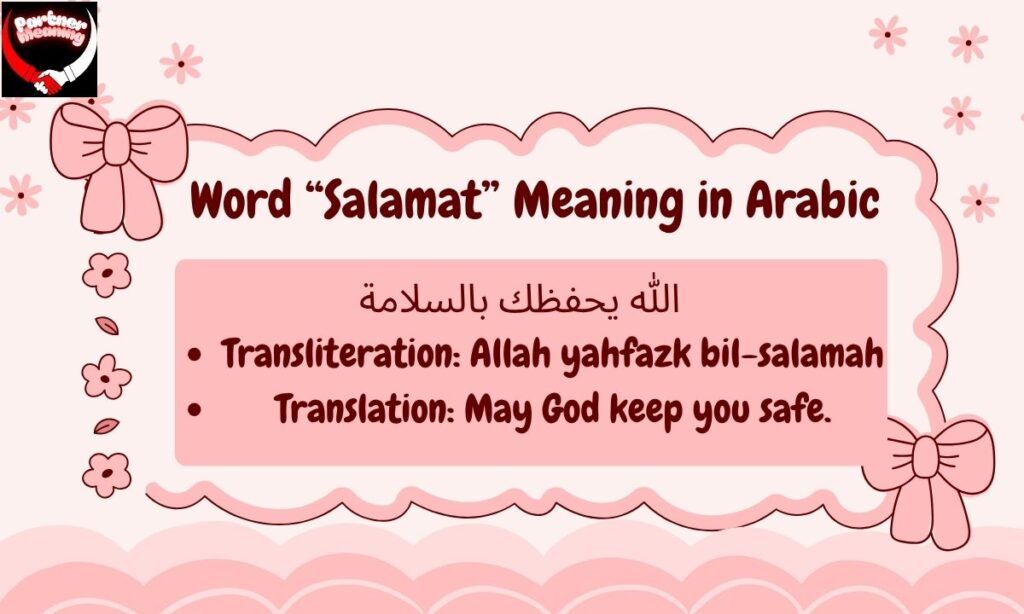
- الله يحفظك بالسلامة
- Transliteration: Allah yahfazk bil-salamah
- Translation: May God keep you safe.
- Transliteration: Allah yahfazk bil-salamah
- سلامات على قلبك!
- Transliteration: Salamat ‘ala qalbak!
- Translation: Blessings on your heart!
- Transliteration: Salamat ‘ala qalbak!
- رجعنا بالسلامة
- Transliteration: Raj’na bil-salamah
- Translation: We returned safely.
- Transliteration: Raj’na bil-salamah
- أتمنى لك السلامة دائمًا
- Transliteration: Atamanna laka al-salamah da’iman
- Translation: I always wish you safety.
- Transliteration: Atamanna laka al-salamah da’iman
Context and Meaning:
| Arabic Phrase | Meaning in English | Usage Context |
| الله يحفظك بالسلامة | May God keep you safe | Travel or leaving home |
| سلامات على قلبك! | Blessings on your heart | Compliment or kindness |
| رجعنا بالسلامة | We returned safely | Returning from journey |
| أتمنى لك السلامة دائمًا | I always wish you safety | General blessing |
These examples show that Salamat is flexible, meaningful, and widely used in daily Arabic life.
Cultural and Islamic Significance of Salamat
Salamat (سلامات) holds an important place in Arabic culture and Islamic traditions. It is more than a word—it represents goodwill, protection, and positive intentions. People use it in prayers, greetings, and farewells, making it a symbol of care and respect.
The root S-L-M (س-ل-م) connects Salamat to key Islamic concepts like Salam (سلام) meaning peace and Islam (إسلام) meaning submission to God. This shows the word’s spiritual depth and cultural importance.
In everyday life, Salamat is often said to travelers, sick people, or anyone in need of safety and blessings. It is a common phrase in homes, schools, mosques, and social gatherings, reflecting community care.
Islamic and Cultural Uses:
- Offering prayers for safety (Allah yahfazk bil-salamah)
- Wishing peace and protection during journeys
- Showing respect and kindness in greetings
- Strengthening community bonds and goodwill
Common Mistakes When Using Salamat
Even though Salamat (سلامات) is widely used, learners often make mistakes in pronunciation and context. Misusing it can confuse listeners or weaken the intended meaning.
A common mistake is confusing Salam (سلام) with Salamat (سلامات). While Salam means peace, Salamat specifically refers to safety, well-being, or blessings. Using one instead of the other changes the message completely.
Another issue is incorrect pronunciation. People often stress the wrong syllable: sa-la-MAT instead of SA-la-mat. Pronunciation is important to show respect for the language and culture.
Common Mistakes:
- Confusing Salam (peace) with Salamat (safety/blessings)
- Mispronouncing syllables, losing clarity
- Using it in the wrong context (e.g., casual phrases without blessings)
- Ignoring cultural etiquette while saying it
Mistake vs Correct Use:
| Mistake | Correct Use | Example |
| Using Salam instead of Salamat | Use Salamat | سلامات على قلبك! |
| Mispronouncing SA-la-mat | Correct pronunciation: SA-la-mat | الله يحفظك بالسلامة |
| Using it casually without meaning | Pair with blessings or prayers | أتمنى لك السلامة دائمًا |
Why Learning the Word Salamat Matters
Learning Salamat (سلامات) is essential for anyone studying Arabic or Islamic culture. It improves communication and helps express care, blessings, and goodwill naturally.
It is used in daily greetings, farewells, prayers, and social interactions, making it a versatile word. Understanding it allows learners to connect better with Arabic speakers and convey respect and positivity.
Knowing Salamat also helps recognize other words from the S-L-M root, such as Salam (سلام), Salama (سلامة), and Muslim (مسلم). This deepens understanding of language, culture, and religion.
Benefits of Learning Salamat:
- Communicate safety and blessings effectively
- Understand cultural and Islamic context
- Recognize related Arabic words
- Show politeness and respect in social interactions
- Enhance daily Arabic conversations and prayers
Final Words
Salamat (سلامات) is a word full of safety, peace, and blessings. It reflects care, goodwill, and positive energy in daily Arabic life. Understanding and using Salamat strengthens communication and shows respect for Islamic culture. This simple word carries a deep, meaningful message for everyone.
Frequently Asked Questions
Is Salamat mentioned in the Quran?
No, Salamat itself is not in the Quran, but its root S-L-M (س-ل-م) appears frequently.
What is the difference between Salam and Salamat?
Salam (سلام) means peace, while Salamat (سلامات) means safety, well-being, or blessings.
How do you pronounce Salamat correctly?
It is pronounced SA-la-mat, with stress on the first syllable.
Can Salamat be used as a greeting?
Yes, it can be used to wish someone safety or blessings in greetings or farewells.
What does Salamat mean in Islam?
In Islam, Salamat conveys protection, safety, and goodwill in daily interactions and prayers.

Hayyat is a passionate writer and researcher who loves exploring the beauty and depth of Arabic language and culture. With a special interest in Arabic names, Qur’anic words, and Islamic heritage, Hayyat aims to share meaningful insights with readers who appreciate names with purpose and history.